
The pitch that numbers alone couldn’t justify — approved, launched, and critically acclaimed.
The pitch that numbers alone couldn’t justify — approved, launched, and critically acclaimed.
Presentation Design
Sales Copywriting
Branding
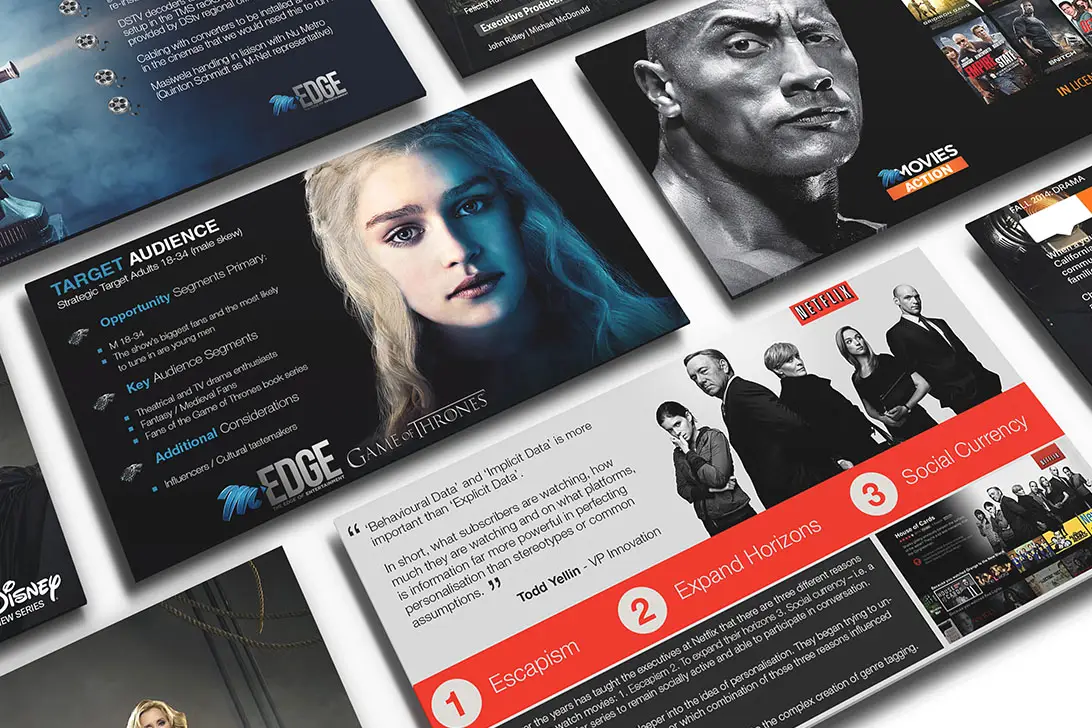
M-Net Edge Channel
The pitch that numbers alone couldn’t justify — approved, launched, and critically acclaimed.
A channel for lovers of film. A curated, cinematic, unapologetically premium content experience — for the audience who always felt the existing offering wasn’t quite built for them.
M-Net Edge Channel
Overview
Jan is a legend in South African media, and for a reason. He built a career on a conviction that turned out to be correct: that what people watch shapes what they feel, and that the audience for genuinely exceptional storytelling was larger, more loyal and more commercially valuable than the market had priced in. M-Net Edge was that conviction made specific. Film. Storytelling. Programming that audiences talk about, recommend and remember. He did not need help having the idea, and he did not need help believing in it. What he needed was to move it through a sequence of rooms — internal stakeholders first, then the Naspers board — each of which would ask entirely reasonable questions he could not yet answer with a chart.
The timing raised the stakes considerably. DSTv was at a commercial inflection point. Netflix was approaching the South African market. Subscriber retention was a live concern. Any new channel proposal landing in that environment would face a sharpened version of the standard question: is this a commercial asset, or is this a passion project wearing a business case? Jan had two advantages. Decades of instinct in an industry he understood better than almost anyone. And Reel Media, who came into the engagement to build out the commercial and content case alongside him. What the pitch had to do was translate a career's worth of judgement into something a boardroom could act on — without pretending to a certainty the category did not yet allow.

M-Net Edge Channel
The Challenge
The structural problem became clear early. The numbers were never going to carry this one — not because the case was weak, but because the category did not exist yet. Audience sizing for a specialist premium channel in South Africa had no local comparable to model against. Content licensing carried real cost. The projections that emerged were credible and honestly built, but a first-of-its-kind concept cannot produce the kind of forecast that makes a board vote feel routine. There was nothing to extrapolate from. In most corporate pitches, thin projections are a problem to solve with more analysis. Here, they were a signal to read correctly. The numbers were not the argument. The concept was. And concepts without precedent are not settled in a spreadsheet — they are settled by conviction.
The audience made it more interesting, not less. The internal stakeholders — department heads, directors, managing directors — were not a generic corporate room. They were media professionals. People who had joined this industry in the first place because they loved it, and who had since built careers on knowing the difference between a real content vision and a manufactured one. They would spot creative conviction instantly, and they would spot its absence just as fast. That cut both ways. Their sophistication meant a generic pitch would not survive first contact. Their seniority meant enthusiasm alone was not enough — they were being asked to stake professional credibility on a board recommendation. The emotional case had to be strong enough to move them. The commercial framing had to be solid enough to protect them.
M-Net Edge Channel
The Solution
The decision that shaped everything: do not lead with what the channel is. Lead with what the channel does — for audiences, for the DSTv brand, and for M-Net's position at a moment when its relationship with premium content needed to be unambiguous. Working with Jan and Reel Media, we built the pitch around the emotional reality of the audience the channel existed for. Not a demographic segment. Not a viewership projection. A specific feeling — being a film lover in a landscape that had never quite curated itself for you, and then finding somewhere that finally had. Once that foundation was in place, the commercial framing landed differently. Not here is the business case for a new channel, but here is why this audience deserves this, and here is the logic that makes backing it defensible.
PowerPoint Adobe Photoshop Adobe Illustrator Sales Copywriting


Design carried an unusual share of the persuasive load. With the forecast unable to lead and the case requiring visceral rather than intellectual engagement, every slide had to work as visual storytelling rather than as a container for data. The standard we held was uncompromising: every slide sells the dream, every visual evokes something, every sequence builds belief rather than describing it. The deck was built to feel like the channel — premium, curated, emotionally intelligent, impossible to dismiss as ordinary. That required resisting a strong instinct. In corporate presentations, when confidence is low, everyone reaches for more data. Here the discipline was to trust the story instead — and let the commercial framing do what it does best, which is justify a conviction the room arrives at by another route. Eight weeks of internal pitching sharpened it every time.
M-Net Edge Channel
Performance Results
After eight weeks of internal engagement, the presentation had done its job. Managing directors, department heads and directors across the Multichoice Group had moved from evaluation to genuine endorsement — not reluctant sign-off, but real belief that the channel was worth backing and worth taking upward. By week twelve, Jan had his approval. M-Net Edge was greenlit, with the Naspers board committing the content investment required to launch. It is worth being precise about credit here. The board did not approve a deck. They approved a well-founded idea from a media leader with an exceptional record, presented in a form that let them evaluate it on the terms it actually deserved. The pitch removed the wrong question. Jan supplied the right answer.
M-Net Edge Channel
Final thoughts
There is a particular kind of idea that arrives before the evidence for it does. The data is honest but thin, because nothing quite like it has been done here before. The projections are credible but not conclusive, because there is nothing to extrapolate from. And the person carrying it knows in their bones that it is worth doing — but cannot transfer that certainty to a room through logic alone. The reflex, in that situation, is to reach for more analysis. More slides. More modelling, in the hope that one more number closes the gap. It usually doesn't, because the gap was never analytical. Backing something unproven is a decision made through conviction and justified afterwards through logic. Jan understood that. The room he was pitching to understood it too — which is why they said yes to a channel the market then spent three years validating. Sometimes the work is not making the numbers stronger. It is making the idea legible enough that people can back it for the reasons they already believe.
M-Net Edge Channel
Credits
Laura Howie
Jan du Plessis
Daryn Basson
Project Lead
Director
Presentation Specialist

Previous Project



The pitch that numbers alone couldn’t justify — approved, launched, and critically acclaimed.
The pitch that numbers alone couldn’t justify — approved, launched, and critically acclaimed.
Presentation Design
Sales Copywriting
Branding
M-Net Edge Channel
The pitch that numbers alone couldn’t justify — approved, launched, and critically acclaimed.
A channel for lovers of film. A curated, cinematic, unapologetically premium content experience — for the audience who always felt the existing offering wasn’t quite built for them.
M-Net Edge Channel
Overview
Jan is a legend in South African media, and for a reason. He built a career on a conviction that turned out to be correct: that what people watch shapes what they feel, and that the audience for genuinely exceptional storytelling was larger, more loyal and more commercially valuable than the market had priced in. M-Net Edge was that conviction made specific. Film. Storytelling. Programming that audiences talk about, recommend and remember. He did not need help having the idea, and he did not need help believing in it. What he needed was to move it through a sequence of rooms — internal stakeholders first, then the Naspers board — each of which would ask entirely reasonable questions he could not yet answer with a chart.
The timing raised the stakes considerably. DSTv was at a commercial inflection point. Netflix was approaching the South African market. Subscriber retention was a live concern. Any new channel proposal landing in that environment would face a sharpened version of the standard question: is this a commercial asset, or is this a passion project wearing a business case? Jan had two advantages. Decades of instinct in an industry he understood better than almost anyone. And Reel Media, who came into the engagement to build out the commercial and content case alongside him. What the pitch had to do was translate a career's worth of judgement into something a boardroom could act on — without pretending to a certainty the category did not yet allow.
M-Net Edge Channel
The Challenge
The structural problem became clear early. The numbers were never going to carry this one — not because the case was weak, but because the category did not exist yet. Audience sizing for a specialist premium channel in South Africa had no local comparable to model against. Content licensing carried real cost. The projections that emerged were credible and honestly built, but a first-of-its-kind concept cannot produce the kind of forecast that makes a board vote feel routine. There was nothing to extrapolate from. In most corporate pitches, thin projections are a problem to solve with more analysis. Here, they were a signal to read correctly. The numbers were not the argument. The concept was. And concepts without precedent are not settled in a spreadsheet — they are settled by conviction.
The audience made it more interesting, not less. The internal stakeholders — department heads, directors, managing directors — were not a generic corporate room. They were media professionals. People who had joined this industry in the first place because they loved it, and who had since built careers on knowing the difference between a real content vision and a manufactured one. They would spot creative conviction instantly, and they would spot its absence just as fast. That cut both ways. Their sophistication meant a generic pitch would not survive first contact. Their seniority meant enthusiasm alone was not enough — they were being asked to stake professional credibility on a board recommendation. The emotional case had to be strong enough to move them. The commercial framing had to be solid enough to protect them.
M-Net Edge Channel
The Solution
The decision that shaped everything: do not lead with what the channel is. Lead with what the channel does — for audiences, for the DSTv brand, and for M-Net's position at a moment when its relationship with premium content needed to be unambiguous. Working with Jan and Reel Media, we built the pitch around the emotional reality of the audience the channel existed for. Not a demographic segment. Not a viewership projection. A specific feeling — being a film lover in a landscape that had never quite curated itself for you, and then finding somewhere that finally had. Once that foundation was in place, the commercial framing landed differently. Not here is the business case for a new channel, but here is why this audience deserves this, and here is the logic that makes backing it defensible.
PowerPoint Adobe Photoshop Adobe Illustrator Sales Copywriting
Design carried an unusual share of the persuasive load. With the forecast unable to lead and the case requiring visceral rather than intellectual engagement, every slide had to work as visual storytelling rather than as a container for data. The standard we held was uncompromising: every slide sells the dream, every visual evokes something, every sequence builds belief rather than describing it. The deck was built to feel like the channel — premium, curated, emotionally intelligent, impossible to dismiss as ordinary. That required resisting a strong instinct. In corporate presentations, when confidence is low, everyone reaches for more data. Here the discipline was to trust the story instead — and let the commercial framing do what it does best, which is justify a conviction the room arrives at by another route. Eight weeks of internal pitching sharpened it every time.
M-Net Edge Channel
Performance Results
After eight weeks of internal engagement, the presentation had done its job. Managing directors, department heads and directors across the Multichoice Group had moved from evaluation to genuine endorsement — not reluctant sign-off, but real belief that the channel was worth backing and worth taking upward. By week twelve, Jan had his approval. M-Net Edge was greenlit, with the Naspers board committing the content investment required to launch. It is worth being precise about credit here. The board did not approve a deck. They approved a well-founded idea from a media leader with an exceptional record, presented in a form that let them evaluate it on the terms it actually deserved. The pitch removed the wrong question. Jan supplied the right answer.
M-Net Edge Channel
Final thoughts
There is a particular kind of idea that arrives before the evidence for it does. The data is honest but thin, because nothing quite like it has been done here before. The projections are credible but not conclusive, because there is nothing to extrapolate from. And the person carrying it knows in their bones that it is worth doing — but cannot transfer that certainty to a room through logic alone. The reflex, in that situation, is to reach for more analysis. More slides. More modelling, in the hope that one more number closes the gap. It usually doesn't, because the gap was never analytical. Backing something unproven is a decision made through conviction and justified afterwards through logic. Jan understood that. The room he was pitching to understood it too — which is why they said yes to a channel the market then spent three years validating. Sometimes the work is not making the numbers stronger. It is making the idea legible enough that people can back it for the reasons they already believe.
M-Net Edge Channel
Laura Howie
Jan du Plessis
Daryn Basson
Project Lead
Director
Presentation Specialist
Previous Project
The pitch that numbers alone couldn’t justify — approved, launched, and critically acclaimed.
The pitch that numbers alone couldn’t justify — approved, launched, and critically acclaimed.
Presentation Design
Sales Copywriting
Branding
M-Net Edge Channel
The pitch that numbers alone couldn’t justify — approved, launched, and critically acclaimed.
A channel for lovers of film. A curated, cinematic, unapologetically premium content experience — for the audience who always felt the existing offering wasn’t quite built for them.
M-Net Edge Channel
Overview
Jan is a legend in South African media, and for a reason. He built a career on a conviction that turned out to be correct: that what people watch shapes what they feel, and that the audience for genuinely exceptional storytelling was larger, more loyal and more commercially valuable than the market had priced in. M-Net Edge was that conviction made specific. Film. Storytelling. Programming that audiences talk about, recommend and remember. He did not need help having the idea, and he did not need help believing in it. What he needed was to move it through a sequence of rooms — internal stakeholders first, then the Naspers board — each of which would ask entirely reasonable questions he could not yet answer with a chart.
The timing raised the stakes considerably. DSTv was at a commercial inflection point. Netflix was approaching the South African market. Subscriber retention was a live concern. Any new channel proposal landing in that environment would face a sharpened version of the standard question: is this a commercial asset, or is this a passion project wearing a business case? Jan had two advantages. Decades of instinct in an industry he understood better than almost anyone. And Reel Media, who came into the engagement to build out the commercial and content case alongside him. What the pitch had to do was translate a career's worth of judgement into something a boardroom could act on — without pretending to a certainty the category did not yet allow.
M-Net Edge Channel
The Challenge
The structural problem became clear early. The numbers were never going to carry this one — not because the case was weak, but because the category did not exist yet. Audience sizing for a specialist premium channel in South Africa had no local comparable to model against. Content licensing carried real cost. The projections that emerged were credible and honestly built, but a first-of-its-kind concept cannot produce the kind of forecast that makes a board vote feel routine. There was nothing to extrapolate from. In most corporate pitches, thin projections are a problem to solve with more analysis. Here, they were a signal to read correctly. The numbers were not the argument. The concept was. And concepts without precedent are not settled in a spreadsheet — they are settled by conviction.
The audience made it more interesting, not less. The internal stakeholders — department heads, directors, managing directors — were not a generic corporate room. They were media professionals. People who had joined this industry in the first place because they loved it, and who had since built careers on knowing the difference between a real content vision and a manufactured one. They would spot creative conviction instantly, and they would spot its absence just as fast. That cut both ways. Their sophistication meant a generic pitch would not survive first contact. Their seniority meant enthusiasm alone was not enough — they were being asked to stake professional credibility on a board recommendation. The emotional case had to be strong enough to move them. The commercial framing had to be solid enough to protect them.
M-Net Edge Channel
The Solution
The decision that shaped everything: do not lead with what the channel is. Lead with what the channel does — for audiences, for the DSTv brand, and for M-Net's position at a moment when its relationship with premium content needed to be unambiguous. Working with Jan and Reel Media, we built the pitch around the emotional reality of the audience the channel existed for. Not a demographic segment. Not a viewership projection. A specific feeling — being a film lover in a landscape that had never quite curated itself for you, and then finding somewhere that finally had. Once that foundation was in place, the commercial framing landed differently. Not here is the business case for a new channel, but here is why this audience deserves this, and here is the logic that makes backing it defensible.
PowerPoint Adobe Photoshop Adobe Illustrator Sales Copywriting
Design carried an unusual share of the persuasive load. With the forecast unable to lead and the case requiring visceral rather than intellectual engagement, every slide had to work as visual storytelling rather than as a container for data. The standard we held was uncompromising: every slide sells the dream, every visual evokes something, every sequence builds belief rather than describing it. The deck was built to feel like the channel — premium, curated, emotionally intelligent, impossible to dismiss as ordinary. That required resisting a strong instinct. In corporate presentations, when confidence is low, everyone reaches for more data. Here the discipline was to trust the story instead — and let the commercial framing do what it does best, which is justify a conviction the room arrives at by another route. Eight weeks of internal pitching sharpened it every time.
M-Net Edge Channel
Performance Results
After eight weeks of internal engagement, the presentation had done its job. Managing directors, department heads and directors across the Multichoice Group had moved from evaluation to genuine endorsement — not reluctant sign-off, but real belief that the channel was worth backing and worth taking upward. By week twelve, Jan had his approval. M-Net Edge was greenlit, with the Naspers board committing the content investment required to launch. It is worth being precise about credit here. The board did not approve a deck. They approved a well-founded idea from a media leader with an exceptional record, presented in a form that let them evaluate it on the terms it actually deserved. The pitch removed the wrong question. Jan supplied the right answer.
M-Net Edge Channel
Final thoughts
There is a particular kind of idea that arrives before the evidence for it does. The data is honest but thin, because nothing quite like it has been done here before. The projections are credible but not conclusive, because there is nothing to extrapolate from. And the person carrying it knows in their bones that it is worth doing — but cannot transfer that certainty to a room through logic alone. The reflex, in that situation, is to reach for more analysis. More slides. More modelling, in the hope that one more number closes the gap. It usually doesn't, because the gap was never analytical. Backing something unproven is a decision made through conviction and justified afterwards through logic. Jan understood that. The room he was pitching to understood it too — which is why they said yes to a channel the market then spent three years validating. Sometimes the work is not making the numbers stronger. It is making the idea legible enough that people can back it for the reasons they already believe.
M-Net Edge Channel
Laura Howie
Jan du Plessis
Daryn Basson
Project Lead
Director
Presentation Specialist
Previous Project


One conversation to find
out if we are the right fit
for YOU
Tell us what you're selling. Who needs to say yes. What's at stake if they don't. We'll tell you exactly what we'd build — and whether we're the right studio to build it.
No obligation. No vague creative brief. A direct conversation about the commercial job your presentation or sales assets needs to do.

One conversation to find
out if we are the right fit
for YOU
Tell us what you're selling. Who needs to say yes. What's at stake if they don't. We'll tell you exactly what we'd build — and whether we're the right studio to build it.
No obligation. No vague creative brief. A direct conversation about the commercial job your presentation or sales assets needs to do.
One conversation to find
out if we are the right fit
for YOU
Tell us what you're selling. Who needs to say yes. What's at stake if they don't. We'll tell you exactly what we'd build — and whether we're the right studio to build it.
No obligation. No vague creative brief. A direct conversation about the commercial job your presentation or sales assets needs to do.